
Trace Blackford County Former Owners
A backward chain begins with a known current deed. Then follow each grantor backward into an older acquiring deed. The working table is a research log, not a claim about any sample parcel. Fill each row from the actual instrument. Retain the legal description and any change in the tract.
| Transfer Date | Grantor → Grantee | Deed Type | Book/Page |
|---|---|---|---|
| Newest verified transfer | Prior owner → current grantee | Copy document type exactly | Instrument or book/page |
| Next earlier transfer | Earlier grantor → prior owner | Warranty, quitclaim, or other type shown | Instrument or book/page |
| Older deed-book entry | Earlier parties as indexed | Copy the historic caption | Deed volume and page |
The legal description is the continuity test. Street numbers change, though. Lot, block, addition, acreage, section, township, and range tie one transfer to the next, even when names, marriages, estates, or party captions shift.
Blackford's 1992 Online Ownership Line
Where does Blackford County's online index begin? Doxpop's current recorder coverage table places the searchable index at January 1992 and scanned images at September 2000. The current table governs. An older 2011 Doxpop announcement gave October 2000 for images, and that one-month difference belongs in your research notes.
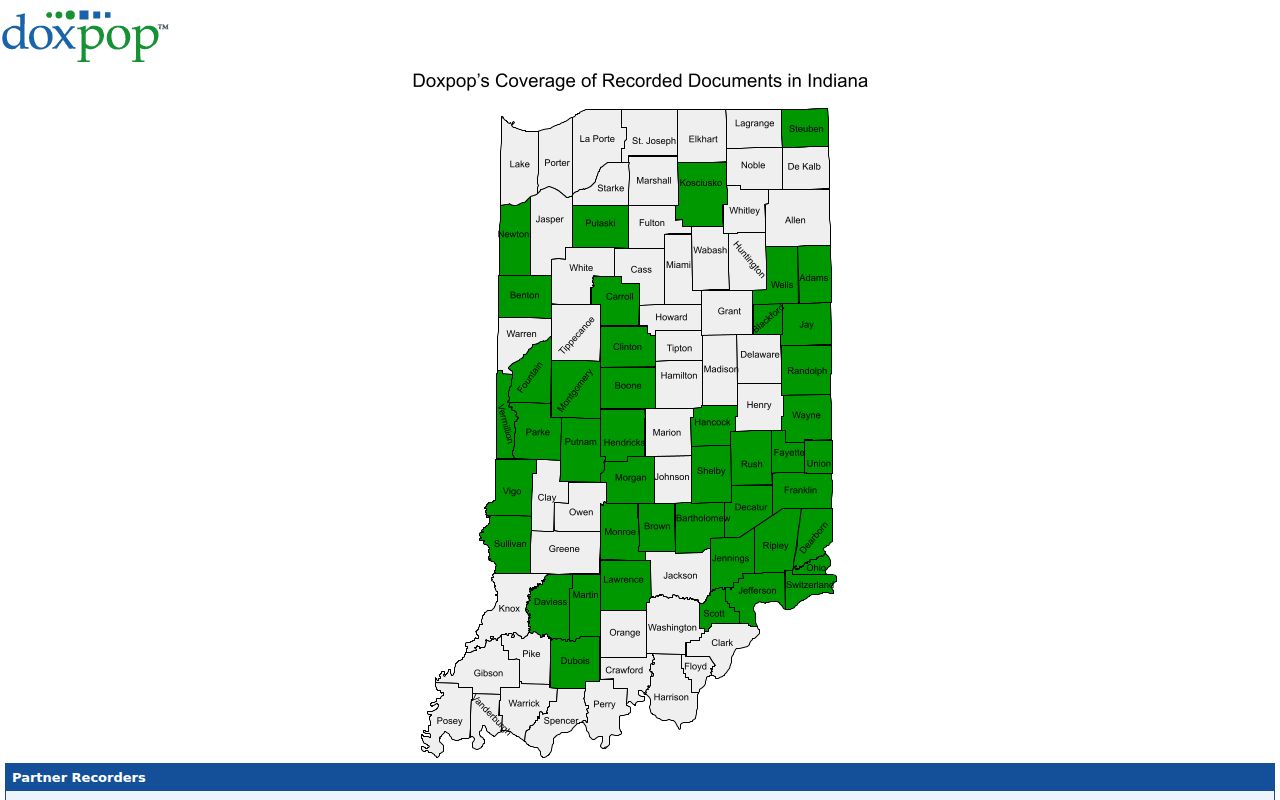
The coverage table sets countywide dates. It does not prove that every indexed line has an image or that any particular chain is complete.
Online cutoff. A search that stops in January 1992 has reached the web index floor, not the beginning of Blackford County ownership history.
Walk Blackford Deeds Backward
Start with the current parcel only. It yields the owner name, property address, and legal description. The assessor owner is a tax-roll field, not a live title statement. Use it to locate the newest recorded deed. Then let the deed's parties and land text drive the older search.
- Find the current owner's acquiring deed with that owner as grantee.
- Copy the grantor, grantee, recording date, deed type, reference, and full legal description.
- Search the grantor as a grantee to find how that prior owner acquired the tract.
- Compare the land description before accepting the hit, then repeat with the next grantor.
- Move to deed books and microfilm when the chain reaches the online coverage floor.
Not every link in a Blackford County deed chain is a warranty deed. Expect more than warranty deeds. Correction deeds, quitclaims, executor or administrator deeds, tax deeds, probate, trusts, corporate mergers, divorces, and parcel splits can all change how an owner appears.
Blackford Former-Owner Terms
Recorder indexes use terms that read backward easily. Define each term before transcribing a long chain, and copy the document's own labels rather than guessing its effect.
- Grantor
- The party conveying an interest, often the seller in a sale deed.
- Grantee
- The party receiving the interest and the name searched for an acquiring deed.
- Chain of title
- The ordered series of instruments linking ownership of the same land through time.
- Reverse index
- An index arranged from grantee names, useful for finding how a past owner acquired land.
- Warranty deed
- A deed carrying stated title covenants; its exact legal effect depends on the document and law.
- Quitclaim deed
- A conveyance of whatever interest the grantor has, without the same covenants as a warranty deed.
Book and page belong to the older bound-record system. An instrument number identifies a recorded item in a newer numbering system, and either reference can lead to the image or official copy.
Earlier Blackford Owners on Microfilm
Once prior owners move before the online index, continue with the Blackford County Recorder and the Indiana State Library's county research materials. The State Library publishes a Blackford microfilm guide with separate grantor and grantee indexes, deed-book volumes, roll numbers, and FamilySearch or GSU references. That inventory is the bridge to older instruments.
Search the grantee index for the former owner's acquisition and the grantor index for the later conveyance. Note the volume and page from the index, then open the deed volume. Copy every land call. If the index spelling is wrong or abbreviated, compare initials, spouses, adjoining owners, acreage, and the legal description.
The Recorder remains the source for an official certified copy. State Library or FamilySearch access helps locate the citation, while the courthouse record supplies the county-held version. Preserve repository, roll, item, volume, page, and search date in the log.
When a microfilm index points to several people with the same surname, read the surrounding entries instead of choosing the first match. A spouse, middle initial, neighboring landowner, acreage figure, or repeated addition name can separate one family from another. Compare both the grantor and grantee sides because an indexer may have shortened a name or entered a firm under a different caption. If the volume citation fails, retain the exact index image and ask Recorder or library staff whether the book was renumbered, rebound, or filmed on another roll.
Plats Reconnect Blackford Ownership
A deed chain can appear to break. Land gets subdivided, replatted, split, combined, annexed, or renamed. County plat books and recorded subdivision instruments show how the lot pattern changed, and they can connect an old tract description to later lot and block deeds.
The Indiana State Library's Blackford map holdings include county, Hartford City, Montpelier, farm-owner, and plat-book material. Treat the map date as a limit. A map may supply an owner or place clue. It does not replace the deed or prove a present boundary.
City land has its own clues. Watch for an original-town plat, addition name, street vacation, or annexation record; for rural land, compare section, township, range, quarter, acreage, and adjoining owners. Rural land compares differently. The same street address can sit on land whose record identity predates the address.
Blackford Ownership Before the County
Blackford County split off from Jay County in 1838 and organized a year later. That timing matters for old land work. A sale can predate the county's own record books. The Indiana State Library's Blackford guide points to early deed, probate, and marriage holdings that help route a search back through those first years of settlement.
Federal land surveys and land-office papers sit with the Indiana Archives or the federal record trail, while later private conveyances live in county deeds. Never leap from a patent holder straight to a modern owner of record. Each transfer in between must be proved on its own. A patent opens one chapter of a tract's history. It is not the whole chain.
Probate can bridge two names when no ordinary sale deed connects them. Court partitions, sheriff's deeds, tax-sale instruments, and quiet-title actions also explain sudden shifts in ownership. MyCase works well as a modern discovery aid. Pull the official court material from the Clerk.
Newspapers Find Blackford Past Owners
The Blackford County Historical Society is digitizing local newspapers, with plans to expand Blackford County Gazette coverage from 1914 through 1937. Hartford City Public Library holds newspaper runs, local-history resources, and a digital microfilm reader. Old pages surface family names, defunct firms, auctions, fires, and street descriptions that no deed mentions.
Treat those finds as leads, not proof. A story that someone lived at or sold a place says nothing about the exact interest conveyed. Carry the name and date back to the deed index, probate file, tax roll, or plat. Note the issue and page. That way the clue stays checkable.
This archive layer earns its keep when a deed index spelling is hard to read, a company changed names, or a familiar building outlived its owner. It adds color around previous owners. It should never stand in for title evidence.
How Far Blackford Ownership Goes
Blackford County former owners can be traced only as far as the surviving deed, probate, plat, and land-office records support the same tract. No honest cutoff date fits every parcel. Index coverage, document survival, spelling drift, and land division all set the stopping point. So does the searcher's own skill.
A records search is not a title examination. It can miss unrecorded interests, indexing errors, probate effects, boundary conflicts, or instruments outside the name range searched. For a purchase, estate, legal claim, or access dispute, get the official copies and rely on qualified title or legal help.
Lawful use. Research into former owners supports house history, estates, and property diligence. Never use a living person's details to stalk, harass, threaten, or cause harm.